


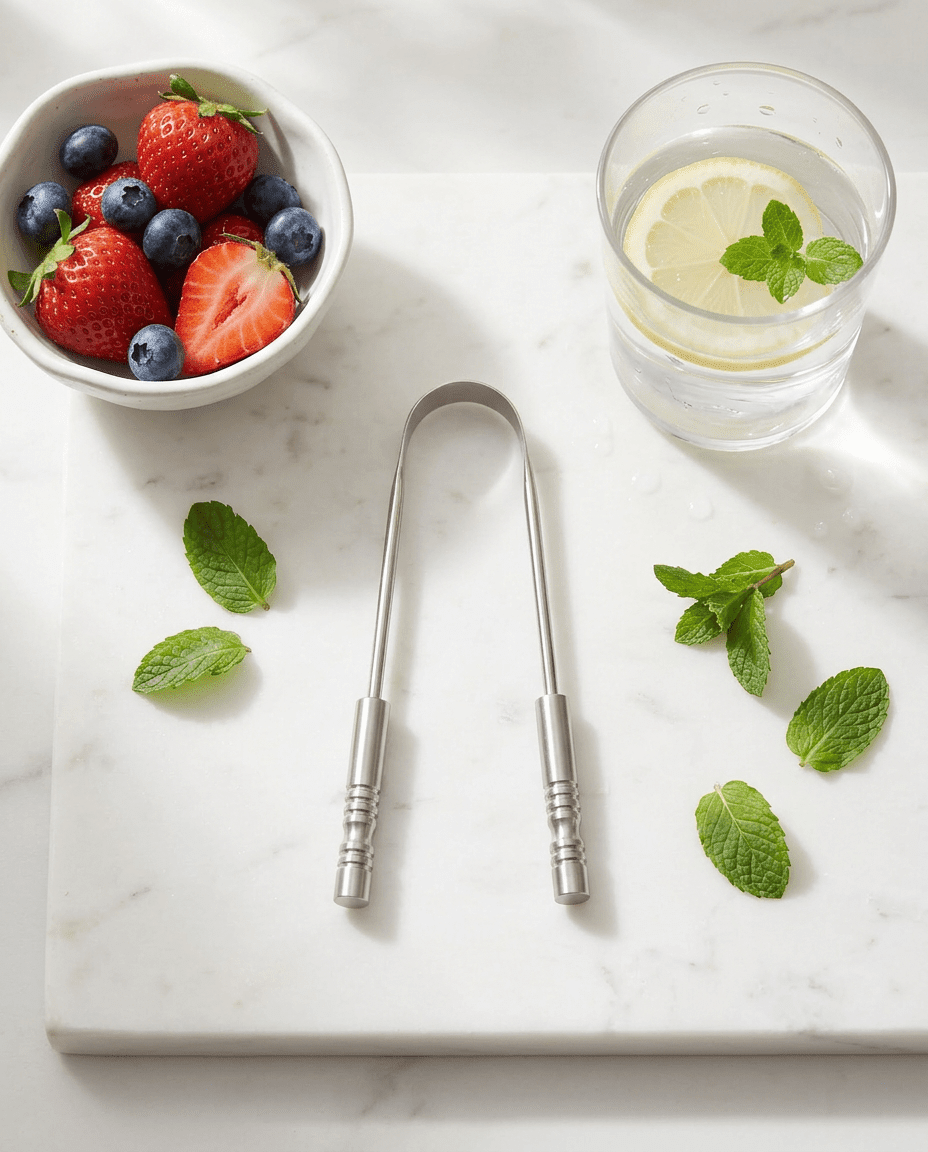
Ten seconds a day, done correctly. Medi explains the entire discipline including the parts everyone gets wrong.
You bought a tongue scraper. Or you are about to, because someone finally told you where morning breath actually comes from. Either way, the tool is simple and the technique matters. This is everything how to use it, when to use it, how to clean it, and what to expect when you look at what comes off. Fair warning on that last one.
What Does a Tongue Scraper Do?
A tongue scraper removes the bacterial coating that builds up on your tongue's surface the film of bacteria, dead cells, and food debris that accumulates overnight. That coating is where most bad breath starts: the bacteria in it produce volatile sulphur compounds (VSCs), the molecules responsible for the smell.
Your mouth hosts around 700 species of bacteria, and the tongue's rough surface is their preferred residence. Brushing your tongue moves the coating around and drives some of it deeper into the surface grooves. Scraping lifts it off and out. Different mechanism. Different result.
Does a tongue scraper actually work?
Yes. Scraping measurably reduces the VSC producing bacterial load on the tongue, and it does so more effectively than brushing the tongue with a toothbrush. It also recovers taste sensitivity over time the coating sits directly on top of your taste buds. People notice food tastes sharper within a couple of weeks. That is not marketing. That is the coating being gone.
How to Use a Tongue Scraper (Step by Step)
- Rinse the scraper under warm water.
- Stick your tongue out. Fully. Half committed tongue extension is the number one technique error.
- Place the scraper as far back on the tongue as is comfortable. The back is where the heaviest coating lives.
- Apply light, even pressure and draw the scraper forward to the tip in one smooth motion. Light means light. You are clearing a surface, not sanding a floor.
- Rinse the scraper. Look at it if you dare. That film is what you were about to swallow with your coffee.
- Repeat two to three times, rinsing between passes.
- Rinse your mouth. Rinse the scraper. Done. Total elapsed time: about ten seconds.
Should You Scrape Your Tongue Before or After Brushing?
Before. Scraping first removes the bacterial coating so your toothbrush and toothpaste work on a clean mouth instead of redistributing what was sitting on your tongue. Scrape, then brush. If you use mouthwash, that comes after brushing rinsing before you scrape just moves the coating around while it is still attached.
This ordering is the entire logic of the MasterMedi routine: floss first, scrape second, brush third. Each step clears the ground for the next one.
How Often Should You Scrape Your Tongue?
Once a day, every day, in the morning. The coating builds overnight while your mouth is closed and saliva flow is low which is why morning breath is a universal experience and why morning is the scrape that matters. If you want to scrape again at night before brushing, that is fine. More than twice daily is unnecessary.
How long should you scrape?
Two to three passes, about ten seconds total. If you are scraping for a full minute, you are pressing too hard, going too often, or enjoying it more than expected.
How to Scrape Without Gagging
Start further forward than you think you should, and move back a little each day your gag reflex recalibrates quickly. Breathe through your nose during the pass. Exhale slowly as you draw the scraper forward. And scrape before breakfast, not after. Within a week, most people can reach the back of the tongue without incident. The coating near the front still counts while you get there.
Tongue Scraper Before and After: What to Expect
First scrape: the residue on the scraper will be white or pale yellow. That is the coating bacteria, dead cells, debris. Everyone has it. Nobody enjoys the first viewing.
Within days: noticeably better morning breath, because the source is being removed rather than perfumed. Within two weeks: sharper taste, a visibly pinker tongue, and the strange new experience of a genuinely clean mouth before 8 a.m.
Why is my tongue still white even though I scrape it?
A few possibilities. Dehydration thickens the coating drink more water. Smoking and certain medications increase it. Coating also rebuilds daily, so a white tongue at night after a morning scrape is normal, not failure. But if the white is patchy, painful, or does not lift with scraping at all, that can indicate oral thrush or another condition that is a dentist conversation, not a scraping harder situation.
How to Clean a Tongue Scraper
Stainless steel: rinse under warm water after every use that is the daily requirement in full. Once a week, wash it with soap and warm water. To sterilise, pour boiling water over it. No dishwasher needed, though steel survives one.
How to clean a tarnished copper tongue scraper
Copper tarnishes. That is copper doing what copper does, and it does not affect performance or safety. To remove the tarnish: rub with a paste of lemon juice and salt, rinse, dry. Thirty seconds. Do not use harsh chemical cleaners and do not put copper in the dishwasher. Rinse and dry it after each use to slow the tarnish down.
How often should you replace a tongue scraper?
Metal scrapers effectively do not wear out. Inspect the edge occasionally; if you ever see nicks or roughness, replace it. Most people never do. This is the rare oral care product with no replacement schedule and no subscription. We sell it anyway. On principle.
Copper vs Stainless Steel: Which Should You Buy?
Both scrape identically. The difference is what the material does between scrapes. Copper is naturally antimicrobial bacteria transferred onto its surface do not survive there. It is the traditional Ayurvedic material with roughly 3,000 years of daily field testing, and it asks a little more care (rinse, dry, occasional de tarnishing). Stainless steel is inert, zero maintenance, and surgical grade durable.
Choose copper if the self sanitising property appeals and you will dry it after use. Choose stainless steel if you want the tool that tolerates total neglect. There is no wrong answer here except plastic plastic flexes under pressure, develops bacteria harbouring micro scratches, and needs replacing. The material is the product.
Can You Use a Spoon as a Tongue Scraper?
In an emergency, yes a spoon's edge drawn forward across the tongue removes some coating, and it is better than nothing in a hotel room. As a daily tool, no. A spoon's edge was designed for soup: wrong curve for a tongue, wrong edge profile for a clean pass, no way to apply even pressure across the surface. The dedicated tool costs less than the takeaway you had last night and lasts a decade. This is not a difficult purchasing decision.
Quick Answers
Do dentists recommend tongue scraping? Many do, particularly for bad breath. Show yours the scraper and ask that beats any sticker on a box.
When should you scrape? Every morning, before brushing.
Does it help bad breath? Yes it removes the primary source rather than masking it. Faster than any mint.
How do you store it? Rinse, dry, stand it in the travel case or a dry cup. Not loose in a damp shower caddy.
Is scraping every day safe? Yes. Light pressure removes coating, not tissue. Ayurveda has run this trial for millennia.
The Ten Second Habit
Tongue scraping is Step II of the MasterMedi routine after flossing, before brushing. It is the highest return ten seconds in oral care: one tool, no refills, no technique that takes longer than a week to master, and a measurable difference in breath and taste.
The MasterMedi Tongue Scraper comes in stainless steel and copper, both medical grade, both with a travel case, both named Best Overall by people whose job is testing these things. Medi was informed of the awards. He described them as expected.


Leave a comment
This site is protected by hCaptcha and the hCaptcha Privacy Policy and Terms of Service apply.