

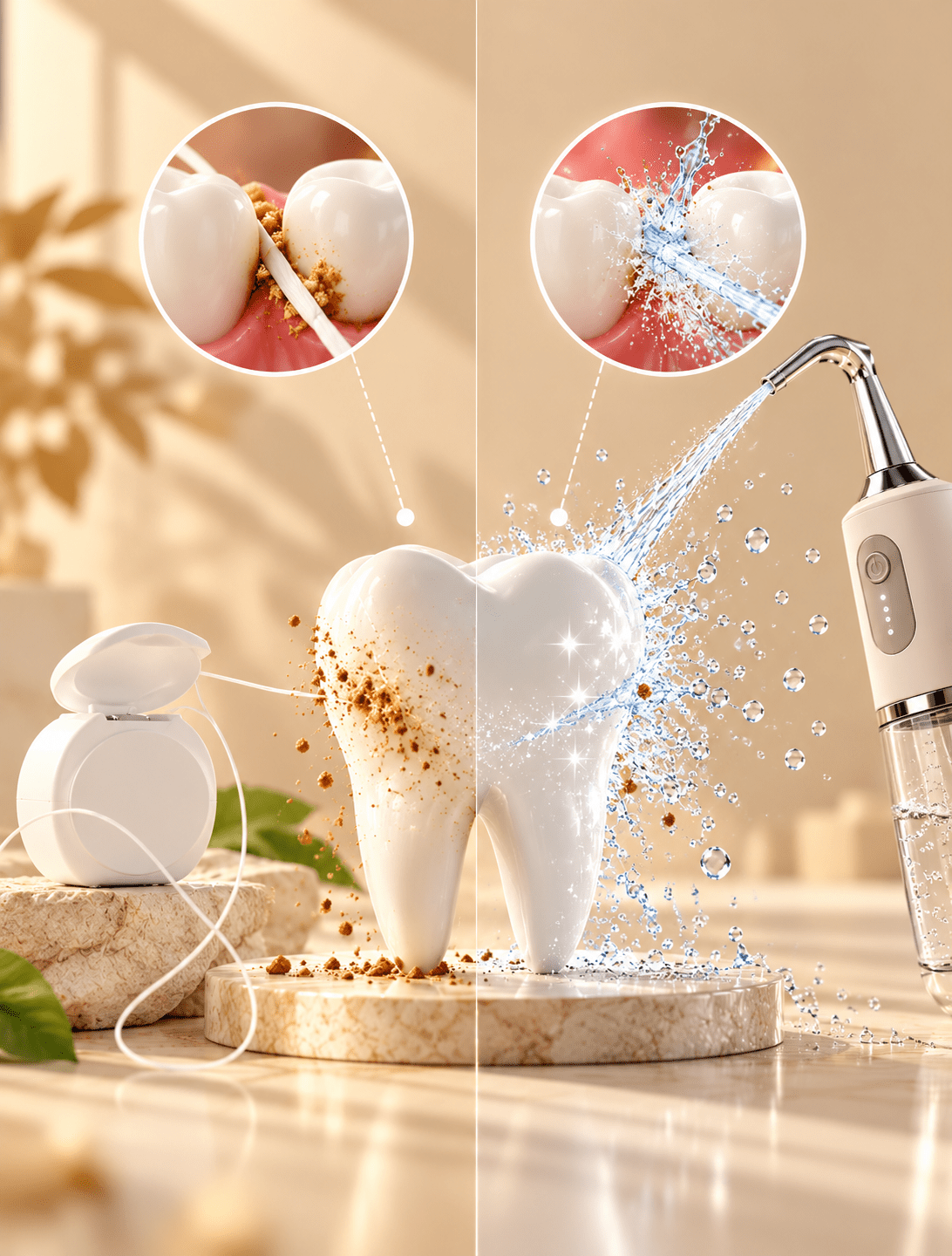
String floss is more effective than a water flosser, provided you use it correctly. Almost nobody does. That single fact explains why dentists disagree about this question and why the research keeps producing results that seem to contradict each other. The tool that wins on paper and the tool that wins in your bathroom aren't the same tool, and the difference is you.
Why the water flosser vs string floss debate never ends
String floss, done properly, physically scrapes the plaque film off the sides of each tooth. It's cheap, it's precise, and in a clinical trial with a hygienist supervising technique, it's very hard to beat.
The trouble is the phrase 'done properly'. Correct flossing means wrapping the string around each tooth in a C-shape, sliding below the gumline, and moving up and down against the surface — for every gap, on both sides, without snapping the floss into the gum. Most people saw the string back and forth between the teeth, miss the gumline entirely, and stop as soon as it bleeds. Surveys consistently find that only a minority of adults floss daily at all, and of those, a majority use a technique that removes very little.
So the honest comparison isn't string versus water. It's string-as-actually-used versus water-as-actually-used. That's a different contest.
There's also the question of what floss is for in the first place. Dental plaque is a biofilm — bacteria in a self-made matrix that adheres to the tooth. Left undisturbed for around 48 hours it begins to mineralise into tartar, which no home tool removes. So the job of any interdental cleaner isn't just to shift food; it's to break up that film daily, everywhere the toothbrush can't reach, before it hardens. String does this by contact. Water does it by pressure. Both work only where they actually get to.
What the research says about water flossers and string floss
Studies comparing the two have measured three things: plaque removal, gum bleeding, and gingivitis. On plaque, results are mixed — some trials favour water flossing, some find them equivalent, and supervised string flossing generally does well. On bleeding and gingival inflammation, water flossers have a more consistent record. Several trials report significantly greater reductions in bleeding on probing after water flossing than after string, over periods of two to four weeks.
The likely explanation is reach. A pulsed water stream gets below the gumline and into the sulcus more reliably than string does in untrained hands, and it flushes bacteria out of places a string can't fold into — around implants, under bridges, through orthodontic wire. It also has no technique penalty. You aim it at the gumline and move along. There's no way to do it badly enough to make it useless, which can't be said of string.
What a water flosser does less well is mechanical scraping of a mature, sticky plaque film on flat tooth surfaces. For that, contact matters. Which is why the best answer in the literature isn't one or the other but the order: water first, to clear debris and reach the gumline, then a brush to do the scraping.
Certain mouths tip the balance decisively. Fixed braces make string flossing slow and frustrating, and compliance drops to near zero within weeks; water flossing around brackets is quick and thorough. Dental implants have a different attachment to the gum than natural teeth, and the tissue around them is more vulnerable to inflammation — pulsed irrigation is the recommended cleaning method for that reason. Bridges have no gap to thread string through at all. Anyone with arthritis or limited hand mobility faces the same technique barrier. In each of these cases the water flosser isn't merely competitive; it's the only realistic daily option.
The last variable is compliance, and it's the one that decides the outcome in practice. A tool used every day at 80 percent effectiveness beats a tool used twice a week at 100. Water flossers have a documented advantage here simply because people keep using them.
The MasterMedi approach to flossing
Step I of the routine is flossing, and MasterMedi's UV Smart Flosser is built around the reach argument. Four modes from 10 to 110 PSI cover first-time users through to people who want a deep clean, and the JET mode handles precision work around specific teeth. The part most water flossers ignore is the tank. Warm, still water sitting in a sealed reservoir between uses is an excellent environment for bacteria, so the flosser runs a ten-minute UV cycle automatically after each session, lab-tested to eliminate 99.9% of E. coli and Staphylococcus aureus in the tank. You're flossing with clean water, not yesterday's.
Who should still use string floss
If you have tight contacts between teeth where a water jet can't penetrate, string floss or an interdental brush remains necessary for those specific gaps. If you floss daily with correct C-shape technique, you're in the minority who get full value from string and should keep doing it — a water flosser adds gumline reach on top, but doesn't replace what you already do well. And if you're travelling without the flosser, string is what fits in a wash bag.
How to use a water flosser correctly: step by step
- Fill the tank with lukewarm water. Cold water on inflamed gums is unpleasant for no benefit.
- Start on the lowest setting. Move up only once your gums have stopped reacting, usually within a week.
- Lean over the sink and put the nozzle in your mouth before switching on. Everyone learns this once.
- Aim at the gumline at roughly 90 degrees. Pause briefly between each tooth.
- Work the outer surfaces, then the inner, upper then lower. One full circuit takes about a minute.
- Do it before you brush, not after. Clearing debris first lets the toothpaste reach the tooth.
If your gums bleed for the first few days, that's inflammation being disturbed, not damage being done. If it continues past two weeks, see a dentist.
Common questions about water flosser vs string floss
Can a water flosser replace string floss completely?
For most people, yes — a daily water flosser used properly outperforms string floss used badly, and most string flossing is done badly. If you have the technique for string and use it daily, adding a water flosser is still worthwhile for the gumline.
Is a water flosser better for gum disease?
The research on gingival bleeding and inflammation consistently favours water flossing, largely because it reaches below the gumline more reliably. It's the more forgiving tool for anyone with sensitive or bleeding gums.
Do dentists recommend water flossers?
Increasingly, yes — particularly for patients with braces, implants, bridges, or dexterity issues, and for anyone who admits they don't string floss. The remaining disagreement is mostly about people who floss perfectly, and there aren't many of them.
Should I use a water flosser before or after brushing?
Before. Flossing first clears food and loose plaque so the fluoride or hydroxyapatite in your toothpaste can reach the tooth surface. This is Step I for a reason.
How often should I use a water flosser?
Once a day is enough for most people. Twice if you have braces or a history of gum problems.
The best floss is the one you will actually use tomorrow morning.
Four modes, a ten-minute UV cycle, and no technique to get wrong. The UV Smart Flosser is Step I.


Leave a comment
This site is protected by hCaptcha and the hCaptcha Privacy Policy and Terms of Service apply.